Episode Transcript
[00:00:00] Speaker A: Flock cameras and other AI driven surveillance technology has been controversial across much of the country and also in Humboldt County.
Humboldt currently has 11 known flak cameras in operation after installing two more of the ALPR, or automated license Plate Reader cameras in the Willow Creek area.
But the ALPR naming rarely tells the whole story as Phlox camera systems are well known for collecting far more data than than just photos of license plates for its artificial Intelligence powered surveillance network.
Last year, the Humboldt County Sheriff's Office was caught sharing data from the county's Flock Cameras with over 300 law enforcement agencies, all without human oversight. The Sheriff's Department now claims it only automatically shares data with 22 California law enforcement agencies.
Flock cameras not only read license plates, they can recognize individuals by appearance and even their voice, and keeps data on your vehicle like specific dents or bumper stickers. According to Flock Safety, during the past 30 days in Humboldt county, the company has detected 84,829 unique vehicle plates that resulted in 127 hot list hits, meaning their cameras caught someone who was allegedly wanted by law enforcement.
AI Being directly involved with law enforcement is a national issue and one that has caused pain, suffering and embarrassment for many Americans and their families. Flock's AI systems are notoriously inaccurate and there have been multiple arrests in dangerous situations endured by citizens who are incorrectly identified as wanted criminals.
Yesterday, Wednesday, September 23rd, the United States Senate Subcommittee on Crime and Terrorism held a hearing titled Always Flock's Nationwide AI Surveillance Network. While senators and witnesses at the hearing were near total agreement on the dangers of Flock cameras, there were notable absences.
Flock CEO Garrett Langley, along with the CEOs of Axon, Motorola and Verkada were invited to the hearing, but all declined to attend.
Those other companies also produced surveillance technology in use by law enforcement and powered by AI.
Flock attempted its own defense before the hearing via a letter from its legal counsel to Republican Senator Josh Hawley, who is leading an investigation into the company.
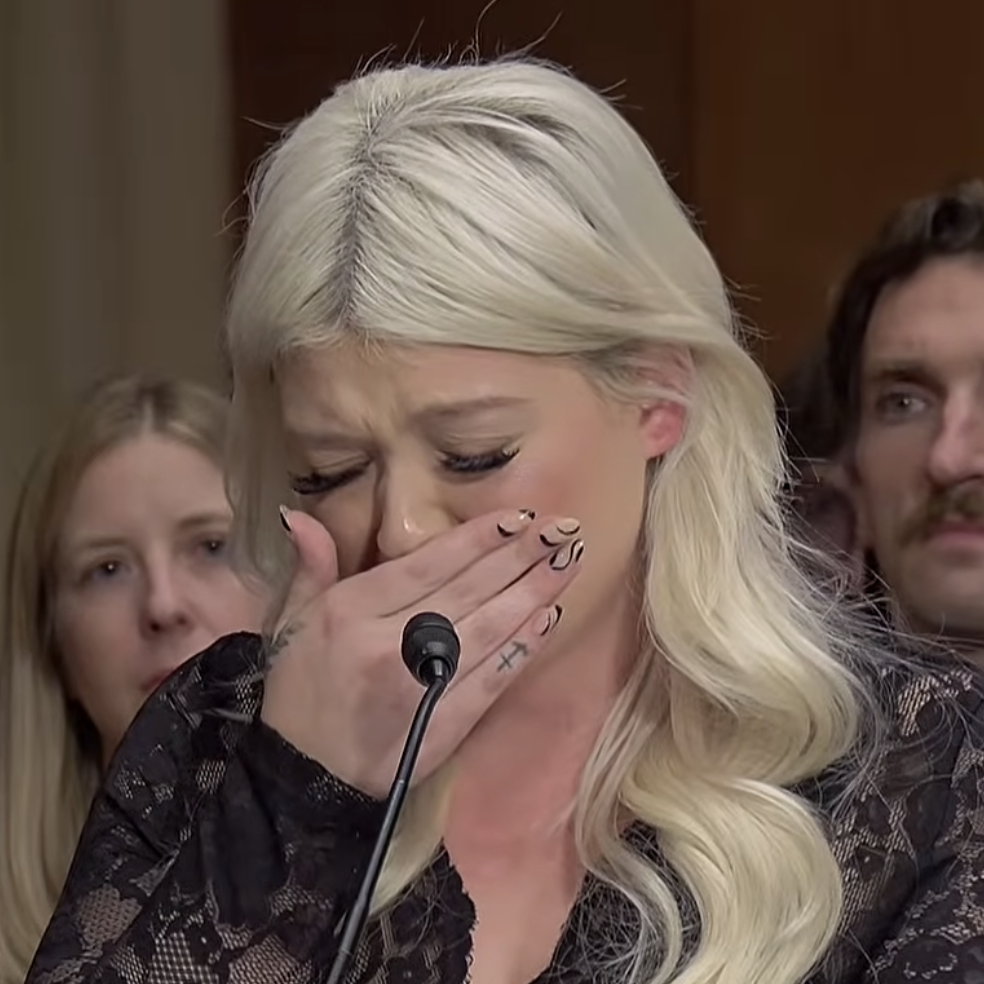
One of the witnesses at the hearing was Lindsay Isaacs, a Florida resident wrongly accused of a crime and imprisoned due to Flock's AI surveillance system. Here's part of her testimony from yesterday's hearing.
[00:02:49] Speaker B: My name is Lindsay Isaacs. I'd like to share with you what happened to me beginning on October 4th of 2025 and how it how it forever changed the trajectory of my Life.
At approximately 1:04am on October 5, an FHP trooper and three deputies from the Marion County Sheriff's Office arrived at my parents home in Ocala looking for me.
They asked where I was and where my vehicle was and told my parents that I had been involved in a fatal crash.
My parents were confused and terrified.
They told law enforcement I was home asleep in Palm coast and gave them my address. They could not understand what they were being told and they were now worried about whether I was even alive.
My parents immediately drove to my apartment. They arrived at approximately 4:45am and found additional troopers there already.
I woke up frantic. My parents were at my door, multiple troopers were outside and an impound truck was taking my Dodge Durango away right in front of me.
I gave the troopers my receipt and information showing where I had been. I told them that I had not been involved in any crash. The troopers told me that there was damage to my vehicle consistent with the collision, but I could not see the damage they were describing.
My Durango was in immaculate condition, yet I stood there watching law enforcement take it away while telling me that my vehicle had been involved in a crash where three people died.
Despite this information, the investigation continued to focus on me and my vehicle.
On April 17, 2026, a warrant was issued for my arrest. I was ordered to surrender myself at the Volusia county jail by 2pm I could not understand what was happening. I was placed in solitary confinement for approximately three and a half days.
Correctional officers told me I had to stay there because of the severity of my charges and I could not be housed with other inmates until I had been evaluated.
I was placed in a blue suicide prevention dress with a broken Velcro on the left side. That left me exposed.
The cell door was shut and it was not open for approximately 86 hours. I was then moved into a mental health unit for approximately 24 hours before ultimately being transferred to G Block, a maximum security housing unit where I remained for approximately 10 days.
I was terrified. I was facing the possibility of spending the rest of my life in prison for a crash that I knew I had not been involved in.
[00:05:38] Speaker A: Lindsay Isaacs was eventually released from jail after 13 days when Flock's camera system incorrectly identified her vehicle as part of a deadly crash. A vehicle that had no visible damage and was not even the right color. Other witnesses at the Senate Flock hearing were from law enforcement in the cybersecurity community, along with lawyers from the ACLU and Institute for Justice. Alasdair Whitney, legislative counsel for the Institute for Justice, was one such witness.
[00:06:10] Speaker C: ALPR technology now lets the government do something it could never do before, and that is travel back in time and reconstruct your movements, where you've been and with whom you've Associated, all without a warrant and with the ease of running a Google search.
Governments say they need this kind of frictionless access to fight crime, and the goal is of course laudable.
But as the Supreme Court has said, the warrant requirement is not an inconvenience to somehow be weighed against the claims of police efficiency.
Technology may make surveillance more convenient, but it does not make the Fourth Amendment's protections any less important.
[00:06:49] Speaker A: Sheriff Ross Teeple from Arizona's Pinal county was another witness. Sheriff Teeple expressed support for license plate readers generally, but stated his county canceled their contract with Flock due to fourth Amendment concerns.
[00:07:04] Speaker D: The committee reached out to me because I was one of the first law enforcement leaders in the country to end our contract with Flock.
Make no mistake, that decision was controversial, but it was extremely popular on both sides of the political spectrum. There is a good chance that the fentanyl being sold outside Union Station, right across the street or in your hometown came through my county.
Given those challenges, it would be irresponsible not to equip my deputies with the best technology to help them do their jobs. But I will never allow technology to supersede your rights.
I believe the latest camera networks powered by artificial intelligence and machine learning are capable of violating our citizens fourth Amendment rights. We have entered an area where some camera networks are capable of capturing much more than just a snapshot of a plate on a highway.
If my deputies need a search warrant to put a physical tracker on a vehicle, where is the line for camera systems that build an identical AI driven map of a citizen's life?
We are paving the way to an AI driven surveillance state.
If we allow government funded private surveillance companies to push this envelope blindly, we risk a sweeping judicial correction that could strip away the legitimate life saving aspects of ALPR technology entirely. We must establish clear statutory boundaries for automatic license plate readers. We cannot wait for a future Supreme Court ruling to correct AI overreach.
[00:08:37] Speaker A: After witness statements, Republican Senator Katie Britt of Alabama expressed privacy concerns and conveyed that she is working across the aisle on the issue of AI surveillance.
[00:08:50] Speaker E: We must protect people's fourth Amendment rights. And when we're looking at this, I want to make sure that we're kind of looking at the total picture.
Senator Warnock and I came together and wrote a letter and Mr. Chairman, I'd like to ask unanimous consent that this be submitted for the record.
Thank you.
We talked about our great concern over the widespread reports that there was misuse regarding these automatic license plate readers. In here we talk about many of the good things that we think have resulted, but ultimately believe that appropriate safeguards are necessary to protect against the unauthorized access and abuse that has come to light.
[00:09:34] Speaker A: Democratic Senator Alex Badia of California expressed concerns during the Senate hearing that Flock's AI surveillance system could be used by Immigration and Customs Enforcement.
[00:09:45] Speaker C: Flock claims that it does not partner with ICE and that ICE does not have direct access to Flock cameras or their systems or their data. But we know that ICE is still able to access Flock data through state and local law enforcement agencies that have entered into agreements, cooperative agreements with ICE, known as 287G agreements.
[00:10:09] Speaker A: Oversight concerns on Flock cameras are starting to be addressed at the county level in Humboldt as well. The county's Board of Supervisors recently created a group to craft policy around surveillance technology, with a deadline to create a proposed ordinance by the end of 2027. We won't know what that ordinance might dictate or restrict for at least a number of months.
So for now, local concerns about Flock cameras on the north coast remain. Reporting for KMUD News, I'm April Lewis.