[00:00:01] Speaker A: Throughout most of the United States, wine is not what comes to mind when thinking of Humboldt County.
The ubiquitous cannabis marketplace is often discussed. But within Humboldt, there is a small but mighty group of vineyard sites and winemakers growing a very different cash crop.
Some, like Whitethorn Winery and Miles Garrett Wines, remain decidedly local outfits, while other producers like Joseph Jewell, bring in grapes from Humboldt to produce in other locations. In Joseph Jewell's case in Sonoma's Russian River Valley, perhaps the most consistently recognized and long lived of Humboldt's commercial wine producers is Brycelyn Vineyards.
The winery recently celebrated 40 years of commercial wine production with test vintages dating back to the mid-1970s.
Cayman News attended the festivities held over two days during the Memorial Day weekend. Guests were greeted by a generous array of cheeses, spreads and oysters while sampling a wide variety of wines poured by second generation winemaker Andrew Morris.
Andrew's stepfather, Joe Collins, was the original winemaker and founder who oversaw all vintages at the winery until 2008.
Joe explained how Brycelyn Vineyards as a commercial business started from humble beginnings.
[00:01:25] Speaker B: I, being an architect, I slowly built these buildings over the years. You know, I built the barn first and then behind that barn and then I built the back room and then I built this, this barn with my first cellar.
Because by then I started getting interested in wines and I read all these books on, well, there weren't that many about wine growing. They call it growing grapes for wines.
And they kept saying, oh, they didn't know, they haven't found the climate right for Pinot Noir. And it was cool up here like that. And there had been that same book, even had figures about how hot it was up here. And I said, you know, we ought to give it a shot.
So I put these grapes in right there and about original ones in 1975 or something just to see how they grew. And now that's how I got my start doing this. And it was always, it's always been just for fun.
You know, we had a great following here. I mean, the southern Humboldt community, they were ready to drink their local wines. So we got lucky.
[00:02:44] Speaker A: Experimenting with different varietals was a large part of the early Bryceland Vineyards experience.
Humboldt county in the 1970s was an unknown zone in terms of existing commercial grape operations.
And experimentation was a must to learn which grape varietals which would work best.
Pinot Noir in California was also in its infancy and wouldn't see widespread commercial acceptance in the California wine Marketplace until the 1990s.
What seems obvious now as grapes for Cooler climates in California was not as obvious. Forty plus years ago, current winemaker Andrew Morris was growing up on the Brycelyn Vineyards property during its early days and spoke of his experience and how the winery gained notoriety during. During the process of transitioning to a commercial operation.
[00:03:35] Speaker C: So the story of how it got started, my mother and stepfather, I mean, I grew up here in the house here and was part of helping build this when this was an amateur winery. So there were several families making wine together, and my stepfather had emerged as the leader of that group, as the winemaker in that group. So they were entering wines in the county fair in the amateur division.
And a couple years in a row, they won kind of all of the awards because you're supposed to enter one wine per person, right? But since they were a group of several people, they would enter several wines in each category under different people's names. It's a little bit unfair because Joe was the winemaker on all of them.
And so that's when they realized that was in the mid-80s, and that's when they realized that they wanted to try to make the winery commercial.
So it transitioned from being a group winemaking project to a commercial winemaking project. And I say from an illegally large home wine operation to an inappropriately small commercial wine operation.
[00:04:40] Speaker A: In 1985, original Brycelyn Vineyards winemaker Joe Collins also spoke on how experimentation and a sheer desire for quality naturally led to the winery's expansion.
[00:04:53] Speaker B: Well, I don't know why, because even at that time, Even by the mid-80s, there were just very few winery grapes being grown here. You know, there were very few grapes being grown. And so, I don't know.
Well, I found out that you need to make wine really good. You need to make it in a big enough batch to keep it from going sour and stuff like that. I mean, big size barrel, barrels are good because you can keep the wine sealed in a barrel. You're making it in five gallon jugs. There's too much air involved. And eventually it's really hard to make wine that way and keep it that way, keep it fresh until you bottle it.
So I tell you, our first couple years were really small, and our first couple of wine tastings, we had, you know, a dozen of our friends here. That was it. You know, we just kept doing it.
And then we built that winery and the garage and all these things.
But this vineyard out here was originally had and still has a few odd varieties in it. I mean, a variety of types of grapes, so we know which ones grew best.
[00:06:14] Speaker A: Like many long Lived southern Humboldt businesses and organizations.
Riceland Vineyards is an esoteric anomaly that eschews many of the rules of the marketplace it exists within.
Current winemaker Andrew Morris also spoke on how keeping prices in line with local expectations and building a strong following within the Humboldt marketplace instead of following the booms and busts of the greater California wine market, helped Brycelyn Vineyards reach 40 years of commercial wine production.
[00:06:45] Speaker C: When Joe was getting the winery started, he named it Brycelyn Vineyards, not Joe Collins Winery, because he believes, and I agree with him, that wine is about a time and a place.
And if our winemaking, if we can, we try to figure out what's the natural thing that that place makes and then find a way to frame that so that it, you know, it highlights it. You know, if you know a vineyard can be picked early and make a lighter wine, then you can do that. And if, you know, another vineyard has to be picked later because the tannins need to hang longer. So if you learn about the vineyards and then try to reveal the character of the wine, it should be about the site and the year.
And if the winemaker is successful, then it's not really about the winemaker.
And that's something that I learned from Joe and think that that's right. So I'm trying as much as I can to reveal, Find out and reveal what.
What does Pinot Noir taste like from that site? What does Rose taste like from that side? What does, you know, Malbec from Ishi Pishi Ranch in northeastern Humboldt tastes like? And if I can explore that with curiosity, then I think that's a better. I mean, that's. It's authenticity, and it is not trying to take a square peg and force it into a round hole, which is what I think a lot of big wineries do when they try to make the wines fit the profile that they think the consumer wants, and they end up with much less interesting wine.
If you have a really strong local following, it's more efficient to just deliver wines locally and not have to ship it and pay all that.
When Joe was making Pinot Noir, that was getting some good recognition and there was the big spike, and Pinot Noir got really popular and got really expensive. You know, he raises prices from 25 to $27.
And then there was a big drop off in the Pinot Noir production, And all those $95 Pinot Noir wineries went out of business, and he raised the price to $29. The point is that if you think you're going to go up with the boom, Cycle, you're going to go down with the bust cycle.
And if you maintain a quality product over time, then you can ride through those better than most people.
Not easily, necessarily, but better than most people because you have a built up goodwill in the community.
[00:09:26] Speaker A: Lastly, founder and original winemaker Joe Collins spoke on how he approached his winemaking and differences between the program he ran and the current Brycelyn Vineyards winemaking program overseen by stepson Andrew Morris.
[00:09:41] Speaker B: I think every winemaker has just a little bit of his own technique comes through in the wine, you know, and also including when I started making wine, you know, I mean, I went through changes every year, like, oh man, you know, I tasted some wines of this type and they were super fruity. Maybe we'll try. What do we got to do to make them fruitier? Or, oh, I kind of like this wine over here. It has kind of a more mature, winey taste to it. Well, how do I get that? You know? So I think over a period of years, when I made it those 25 years, that I think I changed my methods too.
And I think that's with Andrew, too. When he started, he was making them quite like mine. Now I think he's got his own way. He doesn't filter his wines. I think that's great. I should, I probably should have not filtered so much, but I think he saw that that's what people were looking for. A simpler, not pristine, perfect, chiseled wine, but, you know, one with softer edges. So he does it that way and I think it's good.
[00:10:50] Speaker A: The event celebrating Brycelyn Vineyard's 40th anniversary over memorial Day weekend was a wonderful example of Humboldt county perseverance and a continued push to keep things going.
Other highlights of the event included the now in bloom and gorgeous rose garden that is on the grounds.
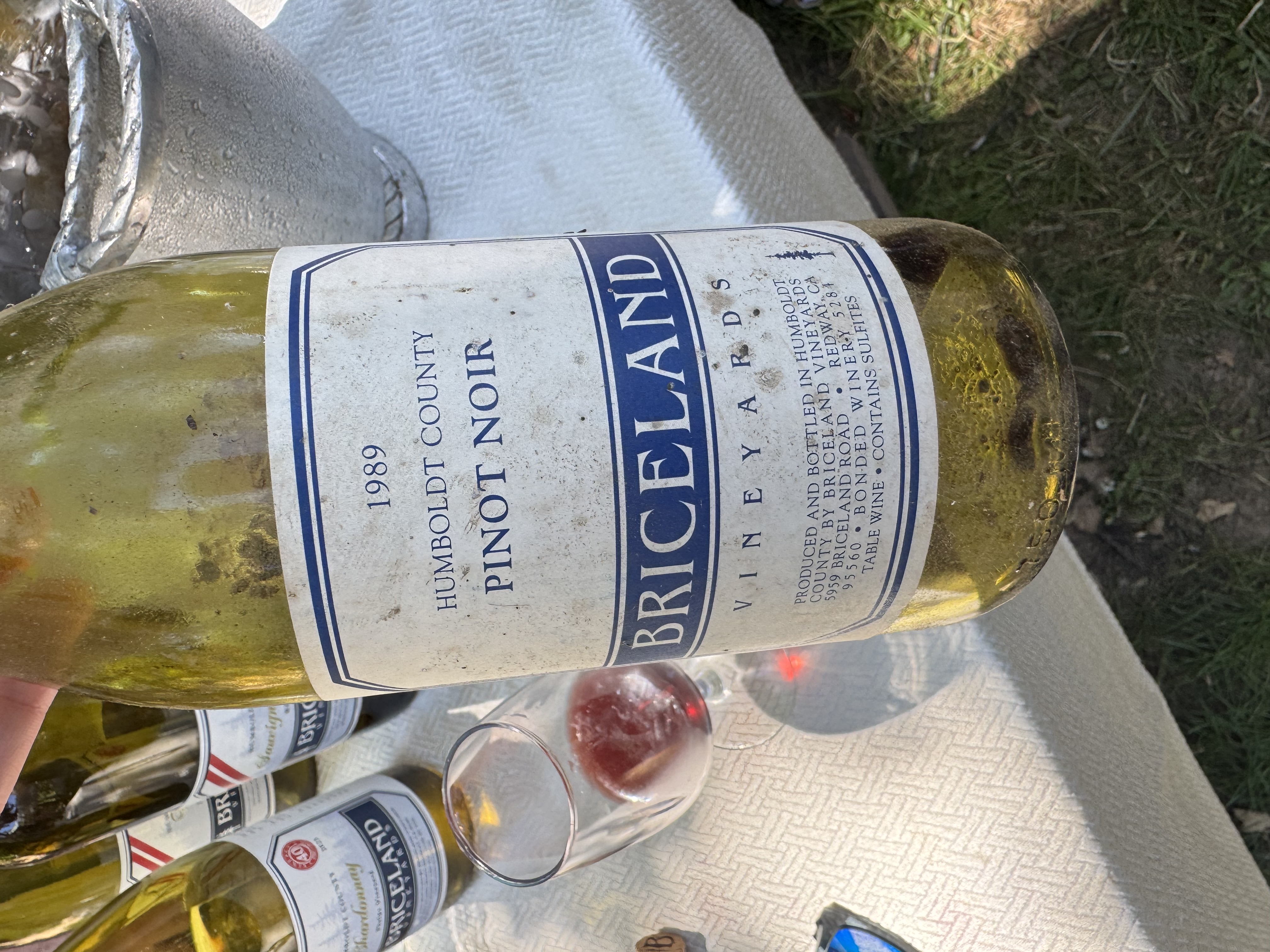
Special wines not usually included in tastings were also presented, including a Spectacular bottle of 1989 Humboldt County Pinot Noir that held up extremely well.
The wine still held bountiful red and blue fruits paired with herbal notes and fine line acidity. With a palate that was seamless and well integrated, a hallmark characteristic of wines that age gracefully.
Modern California Pinot Noirs are not usually known for aging well past 10 years or so, and this clearly was a more Burgundian styled exception to that rule. If you would like to visit Bryceland Vineyards for a tasting of what they've been up to for the last 40 years, you can contact winemaker Andrew
[email protected] or give the winery a call. It's 707-923-2429.
Reporting for KMUD, I'm April Lewis.