Episode Transcript
[00:00:00] You've probably seen the name maybe at the North Coast Co Op in Eureka, maybe at Whole Foods.
[00:00:07] A2A2 milk organic cream topped kefir yogurt eggs.
[00:00:14] The label says local, it says organic, it says humane.
[00:00:18] And for a lot of people in Humboldt county, that label means something. But right now, the company behind that label altogether, Alexander Family Farm, is fighting a civil lawsuit in Humboldt County Superior Court.
[00:00:31] A lawsuit that alleges what happened to the animals on that farm is something very different from what the label promises.
[00:00:41] What you're about to hear is based on court records, a federal investigative file and a year long investigation conducted by the animal welfare nonprofit Farm Forward, the findings of which were first published by the Atlantic magazine in April of 2024.
[00:01:00] Some of what's in those records is difficult to hear.
[00:01:04] Still, it's a matter of public record. And it's happening right here on the Lost coast from Ferndale to Crescent City on farms owned and managed by the Alexander Family Farm Enterprise.
[00:01:19] Theirs is not a small operation.
[00:01:22] It is one of the largest organic dairy producers in the United States.
[00:01:26] The farm has multiple locations from Del Norte county to Ferndale.
[00:01:32] Its products are sold at major grocery chains in all 50 states.
[00:01:37] Co founders Blake and Stephanie Alexander have built a public image around the idea that their farm does things differently and ethically.
[00:01:46] Their website says, we prioritize transparency in everything we do.
[00:01:53] Blake Alexander has spoken publicly about his commitment to animal care. He has described regenerative farming as farming in harmony with nature, in the way God intended.
[00:02:07] The farm was the first certified regenerative dairy in the United States.
[00:02:13] It has carried certifications from multiple organic and humane labeling programs.
[00:02:19] In December of 2025, while a civil lawsuit against the farm was actively proceeding in Humboldt County Superior Court, Blake Alexander stood at a podium at the USDA press event in Washington D.C. alongside him were USDA Secretary Brooke Rawlins and Robert F. Kennedy Jr. Of HHS.
[00:02:43] The occasion was the announcement of a $700 million federal program to promote regenerative farming.
[00:02:51] Alexander Family Farm was there as the face of that movement.
[00:02:56] First, the lawsuit.
[00:02:59] In September of 2024, a Sacramento based nonprofit called Legal Impact for Chickens filed a civil lawsuit against Alexander Family Farm in Humboldt County Superior Court.
[00:03:13] The organization uses civil courts to enforce California's existing animal welfare laws.
[00:03:20] The lawsuit grew out of an investigation that had been underway for months led by the nonprofit Farm Forward, working with the Atlantic magazine.
[00:03:31] That investigation included whistleblower interviews, hundreds of videos and photographs and and first hand observation of conditions.
[00:03:40] What they documented and what the civil complaint alleges is specific.
[00:03:46] According to the complaint, Alexander workers routinely poured table salt directly into the eyes of sick cows.
[00:03:55] Not occasionally, but routinely.
[00:03:58] According to the lawsuit, this practice was carried out hundreds of times across multiple farm locations.
[00:04:07] When a cow developed eye cancer, a common condition in dairy cattle, the response described by whistleblowers, former staff members was not veterinary treatment. It was not euthanasia. It was a piece of old denim clothing sewn into an eye patch and then glued over the animal's eye. That cow would then be sent to auction. According to the complaint, a Farm Forward representative was present at the Humboldt Auction yard in Fortuna when one such animal, referred to in court documents as COW 13039, was sold to a bidder.
[00:04:46] A veterinarian who reviewed the footage of the scene concluded the animal likely had cancer, that its eye had bulged, ruptured, become infected, and, according to the complaint, that the eye patch itself had made things worse.
[00:05:02] The lawsuit alleges the pattern went further than individual animals.
[00:05:07] In 2019, according to the complaint, Alexander ran out of hay.
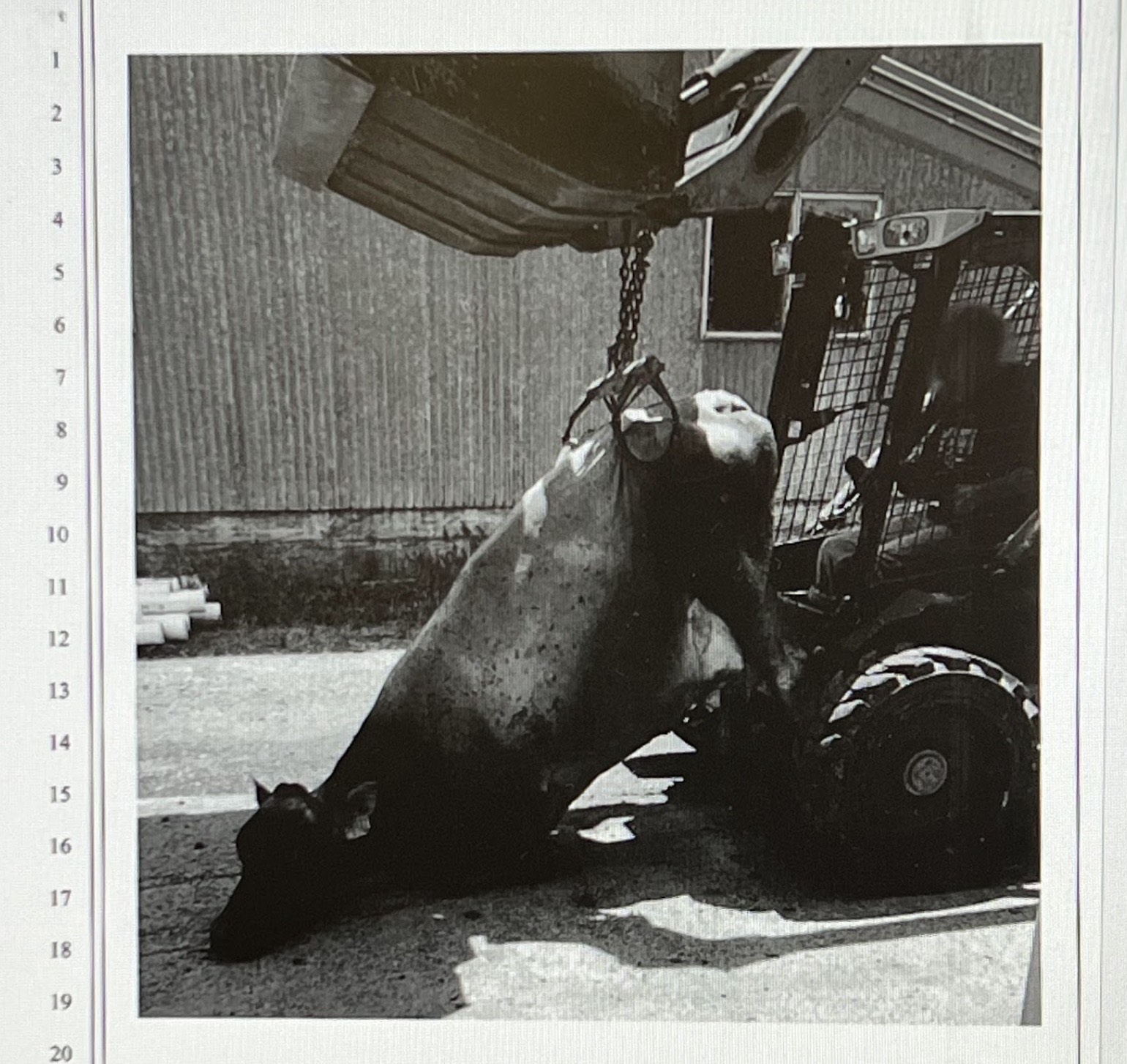
[00:05:12] The lawsuit attributes this to the farm stocking more animals than it could feed and to the farm's failure to pay for grain. When the feed truck finally arrived after several days without food, roughly 800 hungry cattle rushed toward it. They piled onto one another in a stampede. More than 40 animals died in that incident.
[00:05:36] Around 20 others suffered severe injuries, according to the complaint.
[00:05:43] In a separate incident, the lawsuit alleges that approximately 80 pregnant cows were so malnourished that they could not give birth.
[00:05:54] According to the complaint, Alexander's staff had to kill all 80 heifers and all 80 of their unborn calves.
[00:06:03] The complaint describes other alleged practices in detail.
[00:06:08] So many cows died at Alexander Farm, the lawsuit alleges that the farm sometimes maintained pits containing 60 to 70 decomposing animal carcasses at a time.
[00:06:20] According to the complaint, living cows were grazing in the same fields where their herdmates bodies were decomposing.
[00:06:30] In their formal legal response, the farm's attorneys filed what is called a general denial, a response that states, in effect, we disagree with all of it without offering a specific alternative account of what has happened.
[00:06:45] Along with that blanket denial, the farm's legal team raised 23 affirmative defenses, legal arguments that, if accepted by the judge, could end the case before a jury ever hears the evidence.
[00:07:00] Asserting affirmative defenses is a routine step in civil defense procedure.
[00:07:07] Federal regulations governing the USDA's National Organic Program are explicit.
[00:07:14] Those certifications can create pressures for farmers.
[00:07:19] An organic livestock operation cannot sell, label, or represent as organic any animal or product derived from that animal if that animal has been treated with antibiotics.
[00:07:32] The rule exists to prevent antibiotic overuse and to ensure that customers get what the label promises.
[00:07:40] But in practice, that rule puts a farmer in a difficult position.
[00:07:45] If a dairy cow gets sick and the most effective treatment is an antibiotic, administering it means that an animal loses their organic status and the premium price that comes with it.
[00:07:59] Every time a cow is treated, the farm loses money, the lawsuit claims. Alexander resolved that tension by simply not treating sick animals, keeping them in the herd, milking them when possible, and then selling them at auction when they could no longer produce.
[00:08:17] Federal organic rules are explicit on this point as well. An operation must not withhold medical treatment from a sick animal in order to preserve its organic status. Euthanasia must be available for animals in pain, the lawsuit alleges. Alexander violated both of those requirements.
[00:08:39] After Farm Forward's investigation was published, certification bodies took notice. The Regenerative Organic alliance condemned Alexander's wrongdoings and suspended the farm certification.
[00:08:53] The American Society for the Prevention of Cruelty to Animals removed Alexander products from its consumer guide, Certified Humane temporarily dropped Alexander from its list.
[00:09:06] The Northeast Organic Dairy Producers alliance, an industry organization that had previously featured a promotional piece on Alexander, publicly called the documentation of abuse devastating.
[00:09:21] As of early 2026, Alexander Family Farm had begun using a newer certification mark, one described by Farm Forward as significantly weaker than the certifications the farm previously carried.
[00:09:36] That same mark is also used by Butterball and Foster Farms.
[00:09:43] Here's where the story takes a turn that is difficult to ignore.
[00:09:47] Before Blake Alexander ever took the podium at the USDA press event in December of 2025 and before he stood alongside the Agriculture Secretary and described regenerative farming as farming in harmony with nature.
[00:10:02] A federal investigation conducted through the USDA's Agricultural Marketing Services, prompted by Farm Forward's documentation, substantiated multiple allegations against the farm. The investigators described what they found as systematic failures.
[00:10:22] The violations Alexander admitted to as part of a resulting two year settlement program are specific, and they echo almost directly what the civil lawsuit alleges Alexander admitted to dragging cows using hip clamping machinery, removing horns without pain relief, cutting a teat from a cow suffering from mastitis, spraying a diesel fuel mixture on live animals to repel flies, allowing animals to go without feed and animals dying from trampling.
[00:10:58] Those are not allegations from activists. Those are admissions to the federal investigators by Alexander Family Farm itself.
[00:11:09] Rather than facing penalties, the farm entered into a two year settlement program requiring additional oversight.
[00:11:17] The USDA required Alexander to change practices, train staff, and hire an animal welfare consultant.
[00:11:26] And then, approximately one year later, the USDA invited Blake Alexander to stand at a press conference promoting regenerative farming as a national model.
[00:11:39] The civil lawsuit locally has now survived multiple attempts to shut it down.
[00:11:45] Alexander's attorneys made an early motion to have the entire case dismissed, arguing that Legal Impact for Chickens lacked the legal authority to bring this kind of lawsuit at all.
[00:11:57] That motion was denied.
[00:11:59] The farm's legal team then took the unusual step of petitioning the California Court of Appeals, directly asking the appeal court to order the Humboldt County Superior Court to dismiss the case.
[00:12:11] The Court of Appeal denied that request as well. The case was then returned to Humboldt county, where it remains working its way through the litigation process.
[00:12:22] The fight has now shifted to the evidence gathering phase, and it has become its own battle.
[00:12:28] Legal Impact for Chickens served five subpoenas on government agencies.
[00:12:34] Those agencies included the Humboldt County Sheriff's Office, County Code Enforcement, County Department of Health and Human Services, the Del Norte County Sheriff's Office, and the Del Norte County Code Enforcement.
[00:12:47] None of those agencies attempted to block the subpoena requests. The only party that fought to keep those government records secret was Alexander Family Farm.
[00:12:58] The farm's attorneys argued that the records were not relevant, that the lawsuit had no legal basis to proceed, and that internal government files were protected by privilege.
[00:13:10] In May of this year, Judge Timothy Canning rejected each of those arguments and ordered all five agencies to produce their records.
[00:13:20] However, June brought a split result. Judge Canning sided with Alexander Family Farm on two separate evidence motions.
[00:13:28] More than 500 pages of auction yard records produced by the Petaluma Livestock Auction Yard and the Humboldt Auction Yard in Fortuna were designated confidential.
[00:13:41] Alexander's attorneys had argued those records contained proprietary business information.
[00:13:47] Judge Canning agreed.
[00:13:50] The same day, the court ordered Legal Impact for Chickens to provide more complete answers to formal questions submitted by Alexander's legal team. Those two rulings marked the farm's first courtroom wins in this litigation, but they did not address the underlying questions or the underlying allegations in the formal complaint. The question of whether the farm's cattle were systematically abused or not remains before the court.
[00:14:19] What the government agency records contain, whether they corroborate the whistleblower accounts or reveal what law enforcement already knew about conditions at this farm is not yet known.
[00:14:32] Aline Anello, president of Legal Impact for Chickens, offered this statement to redheaded companies aren't above the law.
[00:14:43] California has laws against animal cruelty. We intend to make sure that Alexander Family Farm follows those laws.
[00:14:53] Alexander Family Farm's attorneys did not respond to a request for comment.
[00:14:58] For KMUD news and redheaded black belt, I'm Ryan Hudson.